The situation: a day with nothing in it
Most food diaries have a blind spot. You decide to skip eating for a day, for religious reasons, for a planned fast, or because a long shift swallowed your lunch. You log nothing, because nothing happened. The app dutifully shows zero eaten and zero burned, as if the day did not exist. The reality is that your body spent energy anyway, and across a week that missing figure changes the whole picture.
Sayved’s optional energy baseline exists for exactly this. It counts the energy a body uses just by being alive, so an unlogged day stops reading as nothing.
Before anything else: fasting is not suitable for everyone, and Sayved cannot tell whether it is suitable for you. If you have a medical condition, take regular medication, are pregnant or breastfeeding, are under 18, or have ever had a difficult relationship with food, please speak to a doctor or dietitian before fasting. This page describes a record-keeping feature, not a plan.
How do I set up a fasting log in two minutes?
- Open Settings, then Energy baseline. Enter your height, weight and age, and choose male, female or “prefer not to say” (the formula needs it; the last option uses the midpoint and costs about 80 kcal of precision).
- Pick your day without exercise. The choices are “Desk job, mostly sitting”, “On my feet some of the day”, “On my feet most of the day” and “Physically demanding job”. They deliberately describe non-exercise activity only, because workouts are logged separately and counting them twice would inflate the figure.
- Read the suggested baseline. You see a number with a range, and it is labelled as an estimate from a standard formula, not a measurement. Use it, or type your own.
- Switch on “Count the baseline”. It is off by default and counts from today onwards. Earlier days are left as they were.
The adult calculation is the Mifflin-St Jeor equation. For people under 18 the app uses the WHO/FAO equations, because the adult one underestimates children. It follows your logged weight if you want it to, and when it recalculates, any adjustment you made yourself is kept.
What do I say on a fasting day?
Often, nothing. That is the point. But some people like to leave a note, and you can log whatever else you do:
- “Starting a 24-hour fast now, last meal was dinner at seven.”
- “Black coffee and water only.”
- “Walked for forty minutes, easy pace.”
- “Broke the fast with soup and bread, about six in the evening.”
- “Feeling light-headed, a 4.” (This is a record of what you felt. Sayved will not respond to it, so if it concerns you, stop and seek advice.)
A spoken sentence can become several entries, and the meal you break your fast with can be a quick photo, estimated with a range. See logging food by voice and the food diary. Exercise goes in as you would say it; see the workout log.
What does the net actually show?
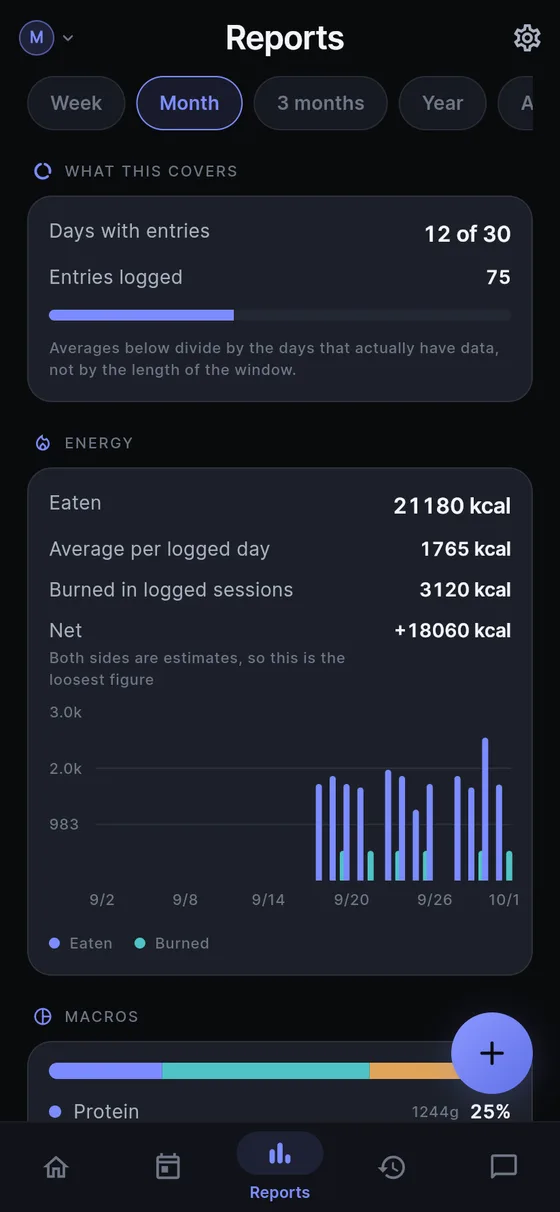
The Today and Home screens show eaten and burned for the day. Where a baseline applies, burned includes it, with a footnote naming the baseline, such as “includes 1,650 baseline”. An unexplained jump in a number would be confusing, so it is always spelled out.
In Reports, choose week, month or longer. The energy view shows what you ate, the burn you logged, the baseline, and the net. The app describes the net and does not judge it: no target line, no percentage, no colour that suggests pass or fail. The app also tells you that both sides are estimates, so the net is the loosest number on the page.
If a day should not count, say you were unwell and not doing anything usual, open Today and choose “Not today” on the baseline line. The baseline drops out for that day, and “Add back” restores it. Nothing is deleted either way.
One thing worth knowing: the baseline is never stored as a diary entry. It is calculated when a day is displayed. That keeps “Nothing logged yet today” honest, and it means your weekly averages are computed from days you actually logged, not inflated by calculated ones. For the full explanation of the figures, read about the calorie deficit tracker.
What can I ask later?
The Ask tab answers from your own entries:
- “How many days in the last month did I log no food at all?”
- “What did I log the day after each of my long fasts?”
- “What did I write about how I felt on fasting days in March?”
- “What was my net for the week of the 10th?”
These return dated entries and totals. Sayved does not tell you whether a fast was good, whether to repeat it or what to eat next. It also does not volunteer comparisons. See charts and reports for how the figures are laid out.
What if I want to show a clinician?
If you fast under a doctor’s or dietitian’s guidance, the doctor report can include food, exercise and how you felt over a period you choose: Settings, then Doctor report, then pick person, period and what to include. The baseline appears as a calculation with its inputs, never as a measurement, and automatic lines are marked “not self-reported”. See what to tell your doctor for the preparation side.
The honest limits
The baseline is an estimate with about a 10 percent margin. The photo estimates have ranges too, and when you subtract one estimate from another the result is loose. The app records and does not recommend. It cannot know whether you are well or whether it is wise to continue a fast. If you feel unwell, stop and seek medical advice.
Your log stays on your phone. To read a sentence or a photo, the text or a downscaled copy goes to an AI model with no name, email or account, and nothing is kept on our servers. Audio is transcribed on the phone and never uploaded. Sayved is 14 days free, then $2.99 a month; what you have logged stays readable and exportable for free, forever. See pricing.
Sayved is a personal record, not medical advice. Fasting is not suitable for everyone, so if you have a medical condition, ask a qualified professional first.
 Sayved