What is a workout log you talk to?
A workout log is a record of what you did and when: the lifts, the runs, the walks. The usual trouble is that logging happens at the worst moment, with chalk on your hands or a phone you don’t want to unlock and type into. In Sayved you say it instead. One sentence, ten seconds, and the session is saved with its details already separated into fields.
It is not a fitness coach and is not trying to be one. It does not build programmes, grade your session or push you towards a number. It keeps your record so that months later you can answer questions like “what was I squatting in March?” without scrolling through notes.
What do I say to log a workout?
Speak the way you would to a training partner:
- “Chest and back, about fifty minutes, bench four by eight at 80.”
- “Ran 6 kilometres, easy pace, around thirty-five minutes.”
- “Walked the dog and carried the shopping, maybe 7,000 steps.”
- “Hiked 14 km with a 15 kilo pack, hard in the second half.”
- “Deadlifts, three sets of three at 140, then stopped because my back felt tight.”
That last one holds two things: the lifts and a remark about your back. One sentence can produce more than one entry, and none of them needs you to choose a category. If you want the back remark kept as its own record, you can say it separately, and it will live alongside your other symptom diary entries.
Exactly which fields get stored for exercise?
An exercise entry can hold:
- Activity, in your words, such as “squats” or “trail run”.
- Duration in minutes. If you don’t give one and none can be worked out from a distance at a realistic pace, it is left empty rather than filled with a round number like 30 or 60.
- Distance in kilometres and steps, when you say them.
- Intensity: light, moderate, hard or unknown.
- Added load in kilograms. This is a first-class field. A 5 km walk with a 20 kg pack is a different event from a 5 km walk, and most trackers can’t see the difference.
- Sets and reps.
- Muscle groups, when they are clear from what you said.
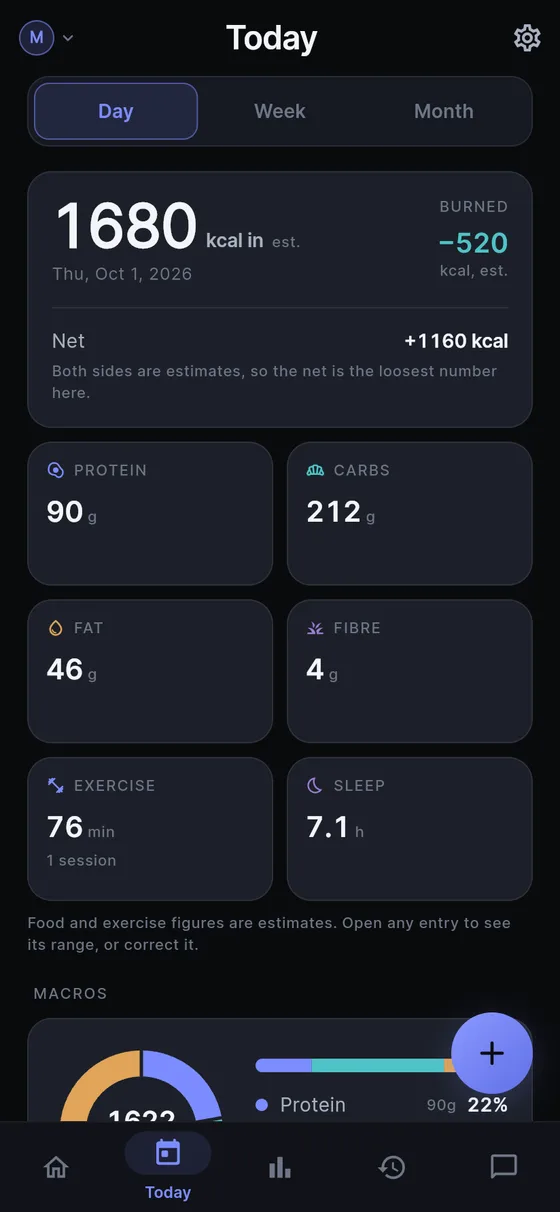
- Energy burned as an estimate with a range, which takes the added load into account.
- Your original words, and the time, which you can change.
Everything derived can be edited. Your correction is saved separately from the first reading, so you can undo it and nothing is lost. You can also tell the app a gym session was an hour when it guessed forty minutes.
How does training show up in Today, Reports and Ask?
- Today lists the session with its duration and logged energy burned.
- Reports shows training and load over a week up to all time, along with steps. If you have turned on the optional energy baseline, burn from logged exercise sits on top of the baseline and is never counted twice. See health charts and reports and the optional net energy view. The charts only describe what you logged, with no targets and no pass or fail colours.
- Ask answers from your own entries: “When did I last deadlift over 140?”, “How many times did I run in September?” or “What was my longest walk with the pack?” It answers when you ask and never volunteers a pattern. See ask your health history.
- Doctor report: if a physio or doctor wants to see activity alongside symptoms, you can include exercise for any person and date range, with estimates kept as ranges.
Can I log the same session without repeating myself?
Yes. If you do the same session, such as a Monday run or a regular swim, save the entry as a routine. Afterwards, one tap logs it and one tap skips it, and a long-press lets you change the amount for that day. Nothing is filed without a tap from you, and a skipped routine is not recorded as a failure. The mechanics are on the one-tap routines page.
What are the honest limits?
Sayved depends on what you say. If you forget to mention a set, it is not recorded. The energy burned for a session is an estimate with a range, not a reading from a heart-rate strap, and there is no wearable integration. It does not suggest weights, count reps from a video or comment on your form.
Voice reading is part of Sayved Pro, which is 14 days free and then $2.99 a month. If you stop paying, everything you logged stays readable, searchable and exportable free forever, and typed entries keep working. Your log lives on your phone, speech is transcribed on the device, and only the text of a sentence goes to an AI model, with no name or account attached. See pricing for the full picture.
 Sayved