The situation: the review is in a week
Imagine a parent whose son uses a reliever inhaler now and then. At the yearly review the nurse asks: how often is he waking at night, how often is the inhaler used, has it changed since the autumn? The honest answer is “quite a bit, I think?” There is a note on the fridge, a few messages to a partner, and a vague feeling about half-term.
An asthma diary is simple in principle: when, what happened, what was used. The trouble is the effort of keeping one. Paper gets left in a drawer, and typing into a form at midnight with a coughing child is the last thing anyone wants. Sayved lets you say it in a sentence and carry on.
Sayved is not a medical tool. It keeps the record you would otherwise have to remember. It does not interpret it.
How do I set up an asthma diary in two minutes?
- Add the right person. If the diary is for yourself, you are already set. For a child or a parent, open Settings, then Family, and add them. Each person has their own separate log file on your phone, so nothing can leak between profiles, and one subscription covers everyone on the device.
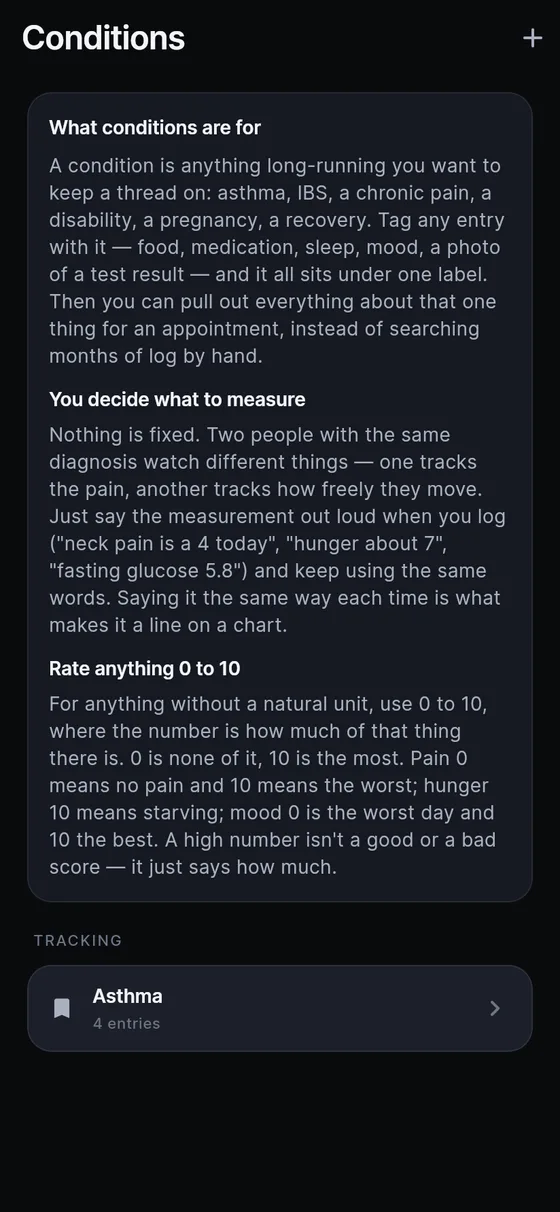
- Create the condition. Settings, then Conditions, and type “asthma”, or whatever word you use. The label is yours and is kept exactly as typed. The app never suggests a condition and never decides that anyone has one.
- Optionally add a routine for a regular preventer. A routine is a saved entry that one tap files as done. If a daily medicine is part of the plan, you can save it once with the amount as your clinician prescribed, then tap it when taken. Nothing is ever filed without your tap, and a skipped routine leaves no trace. It is an input shortcut, not an adherence score.
- Decide about reminders. Off by default. If you want one, write the words yourself (“Evening check?”) and set the time. It stays silent if you have already logged.
What do I say? Example sentences
Press and hold the round button, or tap it and choose voice. Say it the way you would tell a partner:
- “Coughing a lot tonight, breathing about a 5.”
- “Used the blue inhaler, two puffs, after football.”
- “Peak flow 380 this morning.”
- “Woke twice with a cough. No inhaler needed.”
- “Chest tight cycling to work, a 3, settled after ten minutes.”
- “Pollen is high today and he is sneezing, breathing seems fine, a 1.”
A few habits make the diary much more useful later:
- Use the same words for the same thing. “Breathing” every time, not “breathing”, “chest” and “lungs” on different days. Saying it consistently is what makes it a line on a chart.
- State a number when you have one. A number you say always wins over an adjective. If you only say “bad”, the app converts it onto its 0 to 10 scale and shows you the conversion, which you can change with a slider.
- Mention the inhaler when you use it. It is saved as a medication entry with its own date and time, separate from the symptom.
One sentence can create several entries, and you never pick a category. If an entry mentions asthma by name, it is linked to your condition automatically from your own words, and you can remove that link in one tap. When you first create the condition, earlier entries that already mention it are gathered too.
What can I ask my asthma diary later?
The Ask tab answers plain-language questions using only your own entries, and only the rows it needs. It does not volunteer observations. Questions that are useful before a review:
- “How many nights did I log a cough in the last three months?”
- “How many days did I log using the blue inhaler in March compared with April?”
- “What was the lowest breathing rating I logged last month, and on what date?”
- “List every entry that mentions pollen.”
These give you dates and counts from your own record. If the log is thin, the answer carries a caveat. What the numbers mean is a conversation for your clinician. Sayved does not say why one week was different from another.
How do I set up the report for the clinic?
Open Settings, then Doctor report and choose:
- Person: you or the family member.
- What to include: the asthma condition, which limits the document to entries you tagged to it, or everything.
- Period: from one month to a year, or everything. Many people pick the time since the last review.
- Include health, medication and mood: on by default, since symptoms and inhaler use are the core of this report.
The report is a readable page, day by day, in plain language. It can be printed, saved as PDF, or sent beforehand. Ratings you gave are shown as you gave them, and any line the app added automatically is marked “not self-reported”. See the doctor visit report for the full tour and what to tell your doctor for general preparation.
If you are logging for a child, the child health log covers the family side in more depth.
What are the limits, honestly?
Sayved is a diary, not a device. It does not measure lung function, connect to inhalers or read sensors. It only stores what is said, typed or photographed. It has no opinion on whether a reading is acceptable and will never colour a day green or red. It does not recommend doses or frequency and cannot tell you what to do during an attack.
If someone is struggling to breathe, follow their asthma action plan and call the local emergency number. A diary is not for that moment.
Your log stays on your phone. To read a sentence or photo, the text or a downscaled copy goes to an AI model with no name, email or account attached, and nothing is kept on our servers. Audio is transcribed on the phone and never uploaded. The app is 14 days free, then $2.99 a month, and everything you have logged stays readable, searchable and exportable for free afterwards. Details are on pricing.
Sayved is a personal record, not medical advice. Always talk to a qualified professional about asthma and how it is managed.
 Sayved