What is a symptom diary, and how is this one different?
A symptom diary is a dated record of how you felt: what it was, where, how strong and for how long. It exists for one reason. Memory is poor at this. By the time you sit in a consulting room, “a few weeks ago” has blurred, and the answers to “when did it start?” and “how often?” come out as guesses.
In Sayved you fill it in by speaking. There are no forms, no dropdown of body parts and no scale to tap through. You say a sentence, and it is stored as an entry with the date and time. The entry is the record, in your own words, plus a few fields pulled from them.
It is deliberately a record and nothing else. Sayved does not diagnose, explain, reassure or warn. It will not say what a symptom could be or what to do about it. Please read the medical disclaimer, and if you are worried about your health, speak to a doctor.
What do I say to log a symptom?
The way you would tell someone:
- “Headache behind my left eye since this morning, pretty bad, maybe a seven.”
- “Stomach cramps after lunch, a four, eased off by three.”
- “Left knee sore going downstairs, about a two.”
- “Ayla has a temperature, thirty-eight point four, and she’s grumpy.”
- “Woke at night with a tight chest, wheezy, about a five.”
- “Rash on both forearms again, itchy.”
Notice the mix: some have a number, some only words, some a measurement. All of them are fine. Sayved never blocks a capture to ask you a question, because a half-described symptom saved now is more useful than a perfect one you never log. If something is low-confidence, it is saved as that and you can correct it later. Speech is converted to text on the phone and the audio is never uploaded.
Exactly which fields get stored?
A symptom entry can hold:
- Symptom, in a short phrase.
- Body part or location, when you state it, such as “left ankle”.
- A rating from 0 to 10, stored as a measurement named “severity”, or “pain” and so on, when you give one. If you don’t give a rating, there is none. Sayved does not invent a middle value.
- Ongoing, and when it began as you expressed it (“since Tuesday”, “three weeks ago”), so that a continuing problem reads as one thing rather than unrelated rows.
- Readings such as a temperature or blood pressure, stored as a named number with a unit.
- Your original words, verbatim.
- Time, editable, so you can add yesterday’s.
- Condition tags, if you have created any.
Every derived field can be edited. Your correction is saved beside the first reading, not over it.
What does the 0–10 rating actually mean?
There is one scale in Sayved, 0 to 10, and the number is how much of the named thing there is. Pain 10 is the worst pain. Stress 10 is overwhelmed. Mood 10 is the best mood. So a high number is not a good number, and Sayved does not colour it, praise it or warn about it.
Most people say words, not numbers: “bad”, “mild”, “awful”. Sayved reads the word onto the scale, keeps your phrase, and the entry shows a slider with “Read from ‘bad’” beneath it, so the conversion is visible and you can move it with one gesture. If you state a number, the number always beats the adjective. Older entries are converted for display only and are never rewritten. The mood side is covered in the mood journal.
Can I group symptoms under a condition?
Yes, if you want to. You create a condition yourself, such as “migraine”, and then tag entries to it, let Sayved link entries that use that word in your own sentences, or tag past entries after the fact. Sayved never suggests a condition and never names one on its own. The conditions list is yours alone.
If you create a condition and then go quiet on it for three days, Sayved can send one gentle check-in. It never names the condition in the notification, so nothing about it appears on a lock screen. See the chronic condition tracker page, and migraine diary for a worked setup.
How does it show in Today, Reports, Ask and the doctor report?
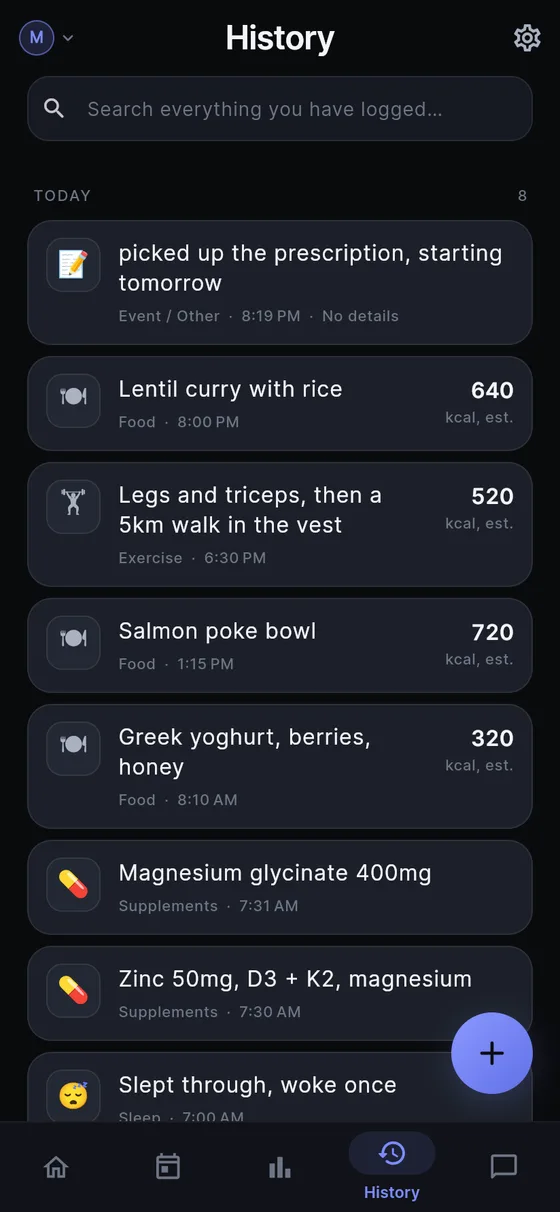
- Today and History list symptoms with their time, rating and location. Charts of a rating group by its name and unit, so two different things are never merged into one line.
- Reports charts your ratings over a week up to all time. They are a line of what you logged. A gap is shown as a gap.
- Ask answers from your own entries, when you ask: “How many headaches did I log in September?” or “When did the knee pain first appear?” Sayved sends only the rows needed to answer, and it never volunteers a link between entries. If it can’t find something, it says so. See ask your health history.
- Doctor report is a printable, dated report for the person, categories and date range you choose. Ratings and readings are included as logged, and any line written by the app and not by you is marked “not self-reported”. See health report for doctor and what to tell your doctor.
Who can see my symptoms?
Health entries are sensitivity 2. They never appear in the home-screen widget, a notification or a lock-screen preview, and a safe export leaves them out by default. Your log lives on your phone, one separate file per person, so a child’s symptoms stay in the child’s profile. To read a sentence, the text is sent to an AI model with no name, email or account attached, and nothing is kept on our servers.
What are the honest limits?
Sayved can only hold what you tell it. It does not interpret anything, cannot tell you a symptom is minor or serious, and has no emergency function. Never use a diary in place of care when you need care. A symptom may be recorded in different words on different days, which is why your original words are stored and searchable.
Reading speech with AI is part of Sayved Pro: 14 days free, then $2.99 a month. After that, everything you logged stays readable, searchable and exportable for free, forever, and you can still type entries. See pricing.
 Sayved