How do I log my mood by voice?
Hold the floating button and say how things are. “Mood’s okay, pretty flat.” “Really wired this afternoon, energy through the roof.” “Anxious before the meeting, stress about an eight.” You do not choose a category, open a form or tap through a row of faces. A long-press records immediately, and the sentence is saved without Sayved stopping to ask you anything.
Speech is turned into text on your phone and the audio is never uploaded. The text goes to an AI model, which reads it, with no name, email or account attached, and nothing is kept on our servers.
Mood does not have to be the whole sentence. “Bad night, then a long walk, and I feel much lighter” can become a sleep entry, an exercise entry and a mood entry from one breath. You say it once.
What gets stored in a mood entry?
Sayved stores a rating only if you gave one. It stores:
- One 0 to 10 reading per thing you named. Mood, energy, stress, focus and creativity are each their own reading, written as a numeric measurement with the unit “/10”. If you only mentioned stress, there is a stress reading and nothing else.
- Your own word, kept as the mood label, such as “good” or “flat”. It is shown under the slider as “Read from ‘good’”, which is the honest way to show that a number was derived from words.
- The time, as you said it (“this afternoon”) and as resolved to a date and hour.
- A neutral one-line summary and any notes that have no field of their own.
- Who or what was involved, if you said it, kept as a separate social entry. “Argument with my sister” is something that happened, which is a different thing from a mood, so it is filed apart rather than guessed into a rating.
What is not stored matters as much. Earlier versions of the app filled in all five ratings on every mood capture, which invented four readings nobody gave. That was removed. A gap in a line of ratings is honest, and a fabricated point cannot be undone later.
How does the 0 to 10 scale work?
There is exactly one scale for every subjective rating in Sayved: mood, energy, stress, focus, a symptom’s severity, pain, hunger, sleep quality. 0 is none of the named thing and 10 is the most of it. Pain 10 is the worst pain. Mood 10 is the best mood. Stress 10 is overwhelmed.
The consequence is deliberate. A high number is not a good number. A good day might be a high mood and a low stress, and Sayved says neither. It will not tint a 9 green or a 2 red, will not congratulate you, and will not compare today with last week.
When you speak in words, Sayved converts them: “good” lands at 7, and the slider sits there with “Read from ‘good’” under it. That teaches the scale as you go, so next time you can say “mood seven” if you prefer. A stated number always wins over the adjective beside it. If the conversion is off for you, drag the slider. Your correction is stored separately and the original reading stays on record.
Rows from before this change used a 1 to 5 scale. They are read and shown converted (1 as 0, 5 as 10) and never rewritten, so an old entry and a new one can share a line on the same chart.
Where do mood entries appear: Today, Reports, Ask, doctor report?
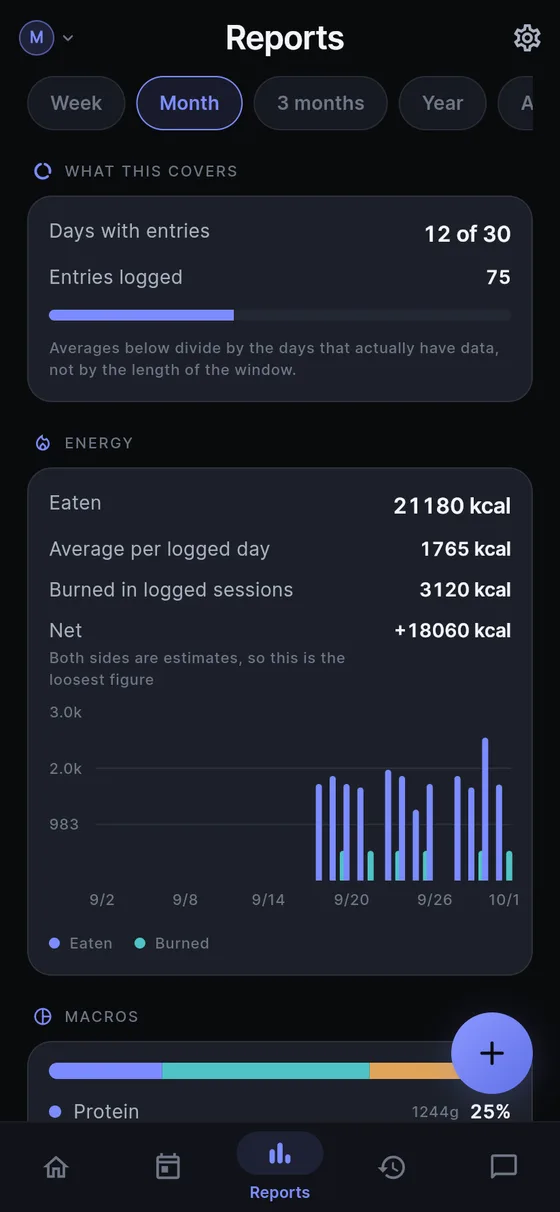
Today lists the day’s entries, mood included, as a record of what you said. Reports can chart mood and focus over a week, a month or longer, grouped by name and unit so a mood line and a stress line stay separate. It describes the line and does not interpret it. There are no goals, targets or pass and fail colours; see health charts and reports.
Ask answers questions from your own entries only: “how did I rate my energy last week?” or “what did I say about my mood after the trip?” Only the rows needed are sent. Sayved will not volunteer a link between your mood and your sleep or your coffee. If you want to compare, you ask. See ask your health history.
The doctor report can include mood alongside sleep, symptoms and medication for a chosen person and date range, but only if you include sensitive categories. Pairing it with the sleep diary or the symptom diary gives a clinician a dated, plain account in your own words rather than a recollection of the last fortnight. See the doctor visit report.
Is a mood journal private in Sayved?
Mood is sensitivity tier 2. It never appears in the home-screen widget, in a notification or in a lock-screen preview. Any export or report asks you each time whether to include sensitive categories, and the default for a safe share leaves them out. Your log lives on your phone, one file per person in the household, so a child’s log cannot leak into yours.
If you stop subscribing, everything already logged stays readable, searchable and exportable, free, forever. Typing entries still works after the 14-day trial, and AI reading of voice and photos, plus Ask, is part of Sayved Pro at $2.99/month. The reminder system, if you choose to use it, is off by default, uses your own words and times, and never says “you missed”.
What are the limits of a mood journal app?
It cannot know how you feel. It records what you said, converted onto one scale, and shows its working. It does not diagnose, assess or advise, and it is no substitute for talking to someone if you are struggling. If you want to attach a long-running condition to your entries, the voice health journal explains how, and that tag is yours to create. The app never proposes one.
 Sayved